Nuffield Health – Designing AI-Assisted Healthcare Journeys (2026)
Exploring how conversational AI can improve patient decision-making, consultant discovery and digital healthcare experiences
Exploring how conversational AI can improve patient decision-making, consultant discovery and digital healthcare experiences
Before designing new concepts, I wanted to understand where users were struggling today and whether AI was solving the right problems.
The discovery phase included reviewing:
Alongside stakeholder discussions, this helped identify opportunities where AI could simplify healthcare decisions rather than simply automate conversations.
As Senior UX/UI Designer, I partnered with Product, Engineering, Digital teams and external AI suppliers to evaluate the existing chatbot experience and explore future opportunities for AI-assisted healthcare journeys.
My responsibilities included:
A key focus of the exploration was moving beyond traditional text-only chatbots towards a more structured conversational experience that combined the flexibility of AI with established UX patterns.
Rather than expecting users to type complex healthcare questions, the experience aimed to reduce cognitive effort by providing guided interactions that helped people discover information more quickly and confidently.
The concepts explored included:
The objective was to combine the speed and flexibility of conversational AI with the clarity and predictability of traditional user interfaces.
This hybrid approach helps users understand what the AI can do, reduces unnecessary typing, improves discoverability of services, and creates a more accessible experience for people who may be unfamiliar with conversational interfaces.
Healthcare decisions often involve uncertainty. Users may not know the correct medical terminology or even what question they should ask.
By providing structured guidance alongside conversational AI, users receive support throughout the journey rather than facing an empty text box with little direction.
The exploration focused on helping users:
The conversational patterns were designed around several core UX principles:
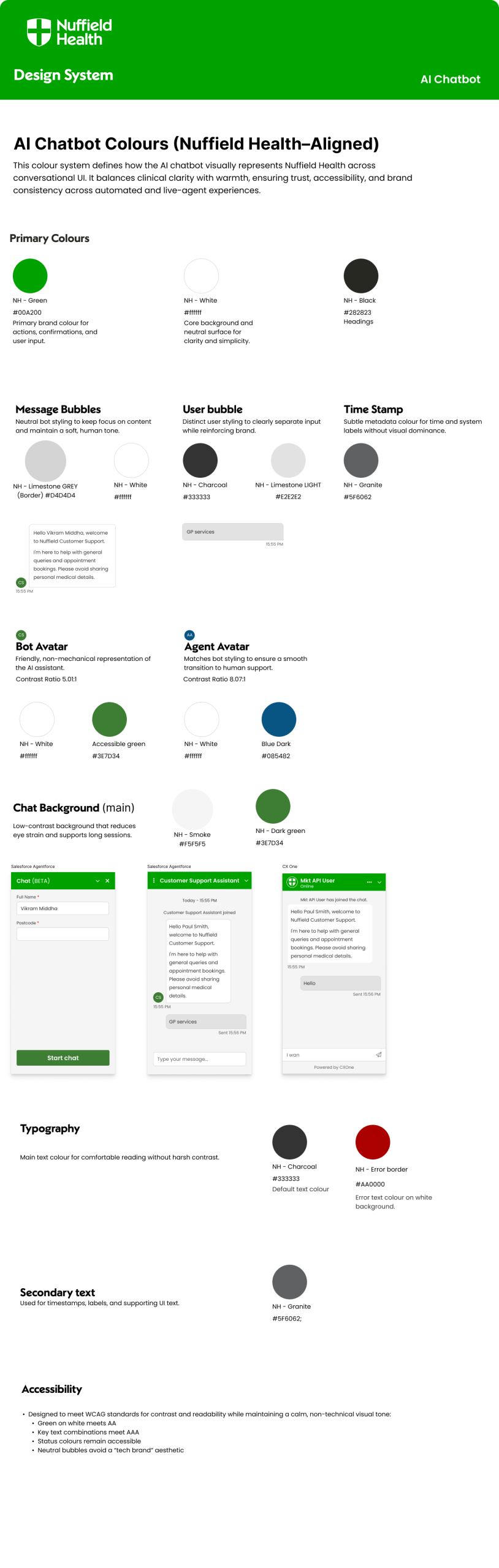
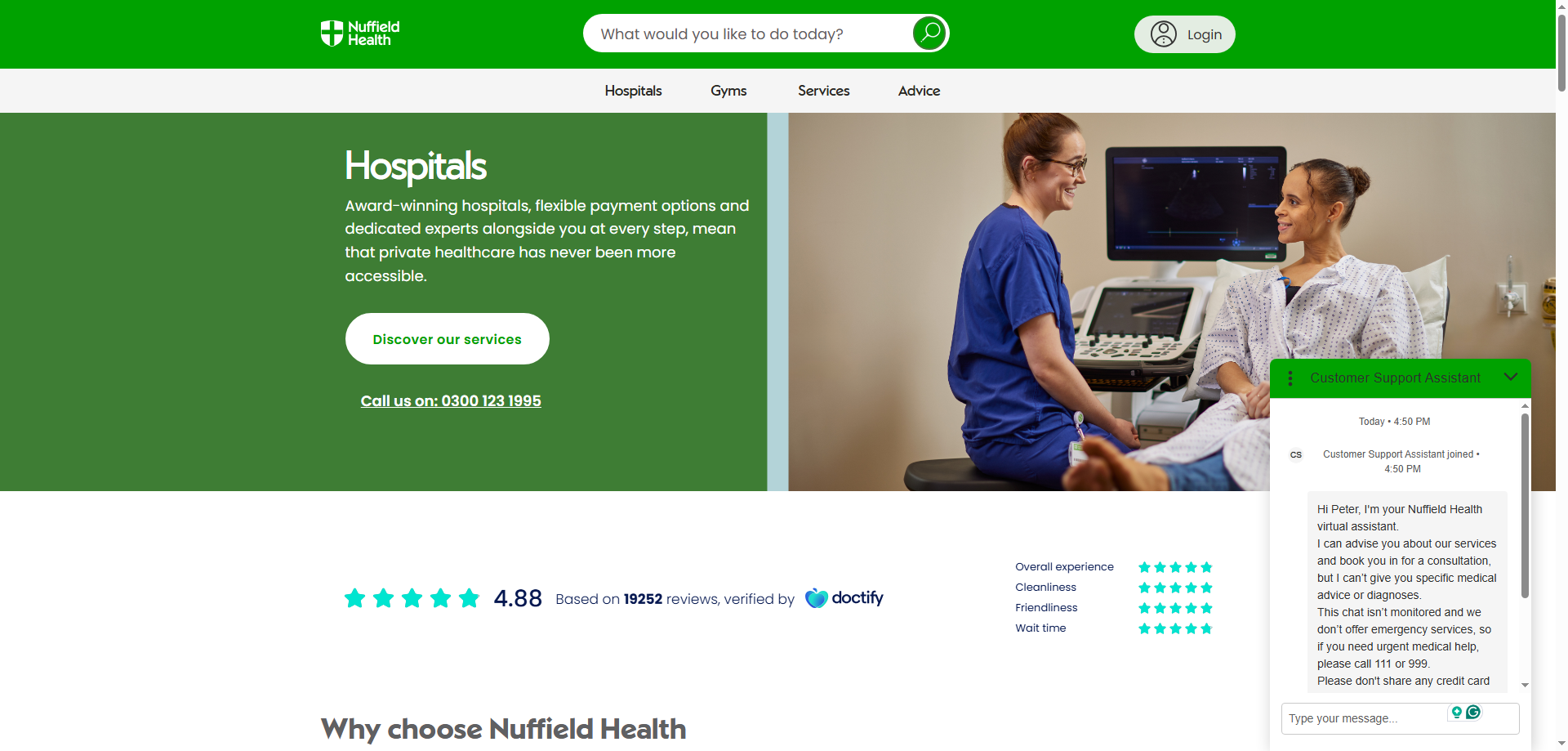
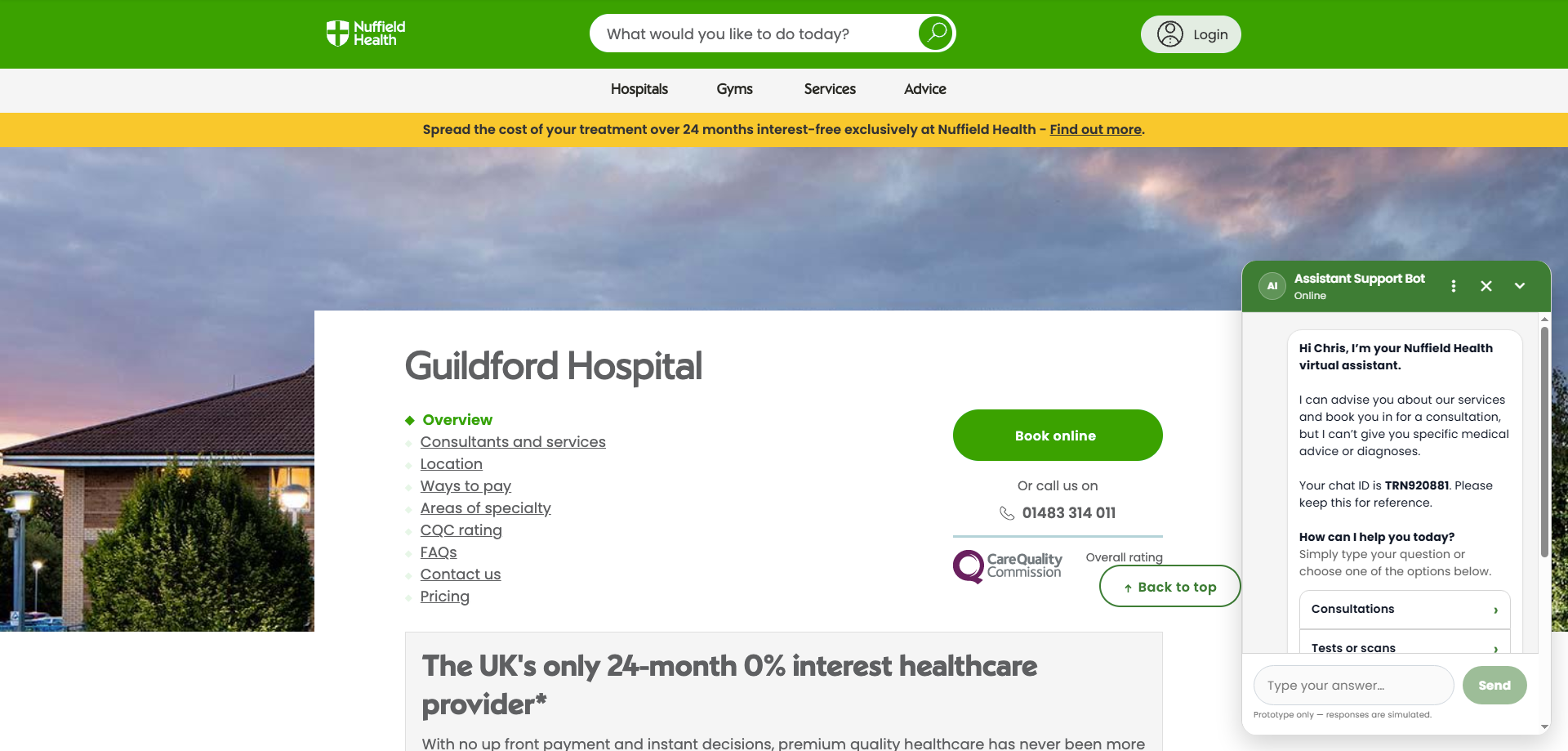
A moderated usability study has been designed to better understand behavioural patterns, trust, and confidence within AI-assisted healthcare journeys, helping inform future conversational UX improvements.
One of the biggest discoveries came through moderated usability testing.
Participants rarely wanted a traditional chatbot.
Instead, they wanted guidance.
Users consistently preferred experiences that helped them:
This shifted the project from improving chatbot conversations towards designing guided healthcare journeys.
The project evolved significantly as research findings emerged.
Originally the focus was:
Improve the chatbot experience
Research revealed a much bigger opportunity:
Design an AI-assisted healthcare guide
Instead of expecting users to know what to ask, AI could proactively support decision-making through guided interactions, recommendations and clearer pathways.
This became the foundation for future product exploration.
Research established four principles that shaped the future direction.
Help patients recognise relevant healthcare options rather than expecting them to search through large amounts of information.
Replace unnecessary typing with buttons, recommendations and structured guidance.
Explain recommendations, surface consultant expertise and provide reassurance throughout the journey.
AI should complement healthcare professionals, not replace them, with clear escalation whenever users need additional support.
Rather than relying solely on free-text conversations, I explored a hybrid conversational experience combining AI with familiar interface patterns.
Concepts included:
The goal was to reduce friction while helping patients make confident healthcare decisions.
To validate the concepts, moderated usability testing was conducted with healthcare decision-makers across both desktop and mobile devices.
The research evaluated:
Research overview
Participants completed realistic consultant discovery and booking tasks while researchers observed natural behaviour, confidence and decision-making.
Importantly, participants were not initially told the study focused on the chatbot, allowing genuine behaviour to emerge without influencing results.
The findings consistently showed that guided experiences outperformed traditional conversational interfaces.
Guidance beats conversation
Users preferred recommendations over typing questions.
Buttons reduce effort
Participants consistently favoured button-led interactions that reduced typing and cognitive effort.
Trust matters
Consultant profiles, recommendations and explanations increased confidence before booking.
Hybrid AI performs best
Combining conversational AI with structured interface components created the strongest overall experience.
Several themes appeared consistently across every moderated session.
“I’d rather them just be buttons.”
“A mixture of buttons and typing works best.”
“I feel more confident after seeing the consultant’s profile.”
Participants weren’t looking for longer conversations.
They wanted reassurance, guidance and confidence.
The research identified several opportunities for future optimisation.
Immediate Improvements
Future Opportunities

The project helped establish a broader vision for AI-assisted healthcare journeys.
Rather than viewing AI as a standalone chatbot, the work explored how conversational AI could become an integrated healthcare guide that supports consultant discovery, treatment navigation and informed decision-making.
The moderated research validated the strategic direction of combining conversational AI with structured guidance, recommendation cards and contextual interactions to reduce effort while increasing confidence.
The work also created a roadmap for future optimisation through continued user research, A/B testing and phased product improvements.
This project reinforced that successful AI experiences are not measured by chatbot engagement alone.
The real value comes from helping people make better decisions.
Patients consistently valued guidance, trust and reassurance more than open-ended conversations.
The biggest opportunity wasn’t building a smarter chatbot.
It was designing a smarter healthcare journey.
This project changed the way I think about AI product design.
Rather than asking:
The more valuable question became:
That shift in thinking transformed the project from a chatbot optimisation exercise into the exploration of a broader AI-assisted healthcare experience, one that puts patient needs, business goals and evidence-based design at the centre of every decision.