Exploring Future AI Products concepts, Apps & Member Journeys (2026)
Exploring how AI could improve healthcare, membership, and digital customer journeys
Exploring how AI could improve healthcare, membership, and digital customer journeys
This exploration looked at how AI-assisted experiences could help shift these journeys towards:
Researched how AI-assisted experiences could help users discover more relevant services, treatments, memberships, and content based on intent, goals, behaviour, and context.
The concepts explored how AI could reduce uncertainty across complex healthcare and fitness journeys by guiding users towards clearer next steps and more relevant recommendations.
Investigated how AI could simplify long-form healthcare and service content into shorter, more digestible summaries tailored to different user needs and levels of understanding.
The concepts focused on improving readability, reducing cognitive overload, and helping users understand complex information faster across treatment and wellbeing journeys.
Traditional site search can often struggle when users are unsure what treatment, service, consultant, or membership they actually need.
This concept explored how AI-powered search could better interpret natural language, symptoms, goals, and intent to deliver faster, smarter, and more relevant results across healthcare and fitness journeys.
Researched recommendation systems designed to simplify complex decisions and reduce uncertainty across healthcare and fitness journeys.
The concepts explored how contextual signals, intent, and behavioural patterns could surface more relevant recommendations tailored to individual users.
Investigated hybrid conversational experiences combining natural language interactions with more structured UX patterns such as guided buttons, recommendation cards, quick actions, and contextual suggestions.
Rather than relying only on traditional chatbot experiences, the concepts explored more visually guided and supportive conversational journeys across desktop and mobile experiences.
Considered how AI-assisted tools could help reduce operational friction across healthcare and fitness journeys through smarter scheduling, personalised communications, guided support, and recovery recommendations.
The exploration also considered how AI could support internal workflows, operational efficiency, and future digital service optimisation.
Explored how AI could generate tailored wellbeing journeys based on goals such as strength, weight loss, rehabilitation, recovery, swimming, or general health improvement.
Investigated AI-assisted nutrition experiences, including personalised meal plans, recovery nutrition, healthy recommendations, hydration reminders, and wellbeing support.
Explored how AI could support recovery journeys through personalised rehabilitation plans, exercise guidance, reminders, progress tracking, and wellbeing check-ins.
Consider how AI could reduce friction across appointment, consultation, class, and facility booking journeys through personalised recommendations and scheduling assistance.
Explored proactive AI-driven insights, reminders, and recommendations based on engagement patterns, recovery trends, inactivity, or wellbeing behaviours.
Explored how AI could improve accessibility through simplified explanations, adaptive content, translation support, and more inclusive healthcare and fitness experiences.

An evolution of the existing gym joining journey, introducing targeted UX and CRO improvements including clearer membership selection, enhanced plan comparison, simplified forms, improved start date selection, stronger payment reassurance, better mobile usability, personalised recommendations, subtle micro-interactions, AI-assisted guidance, and a more engaging confirmation experience.
Includes developer notes and AI opportunity considerations throughout the experience.

A completely redesigned Nuffield Health joining journey focused on member goals rather than membership types, using personalised recommendations, enhanced onboarding, intuitive micro-interactions, clearer decision-making, stronger CRO principles, and a more premium user experience.

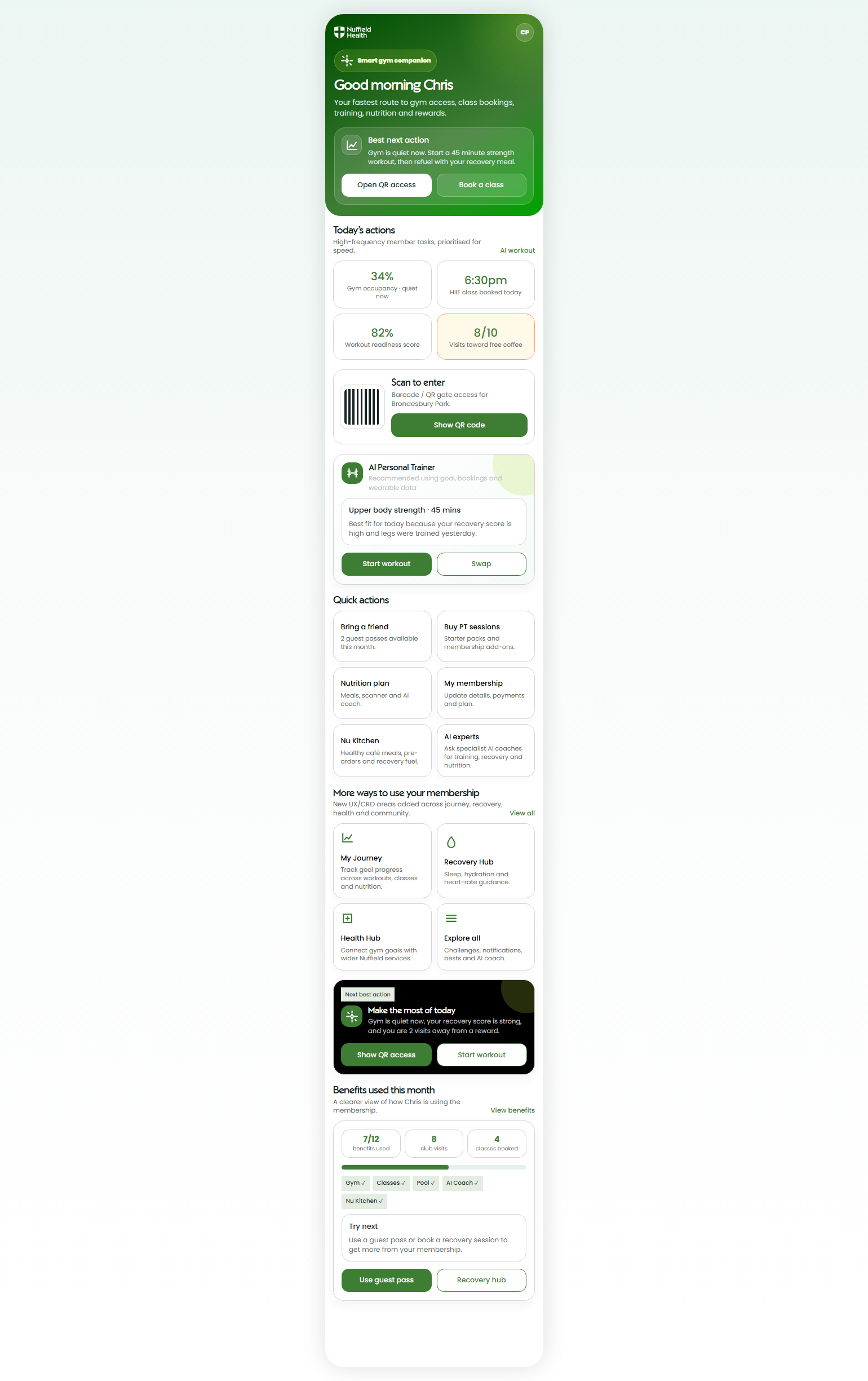
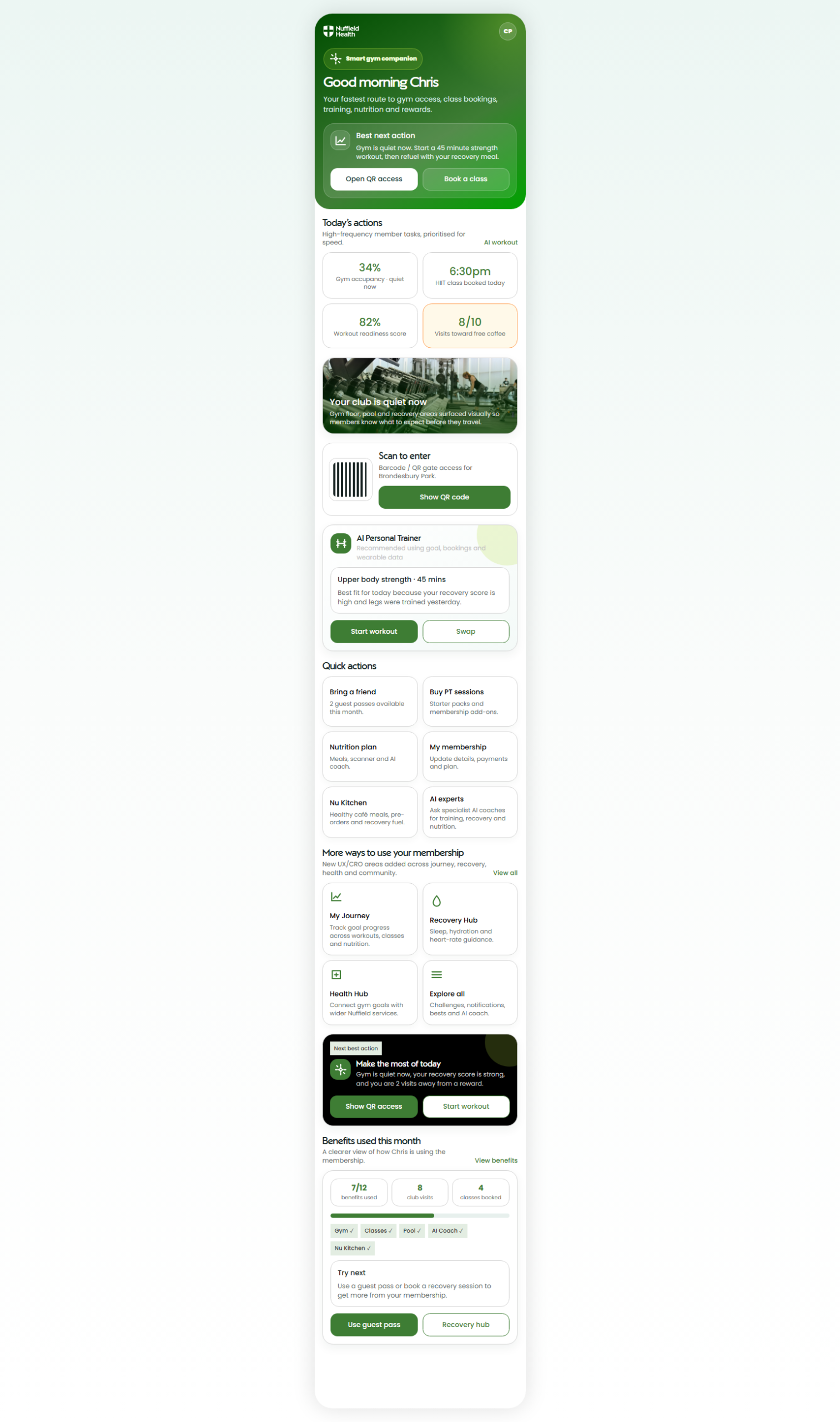
Rather than keeping concepts at the ideation level, selected opportunities were translated into interactive HTML prototypes to explore how AI-assisted experiences could work within real digital healthcare and fitness journeys.
The prototypes focused on:
The goal was not to predict future AI products, but to explore practical, user-centred opportunities where AI could support better experiences, smarter journeys, and more relevant digital interactions.